

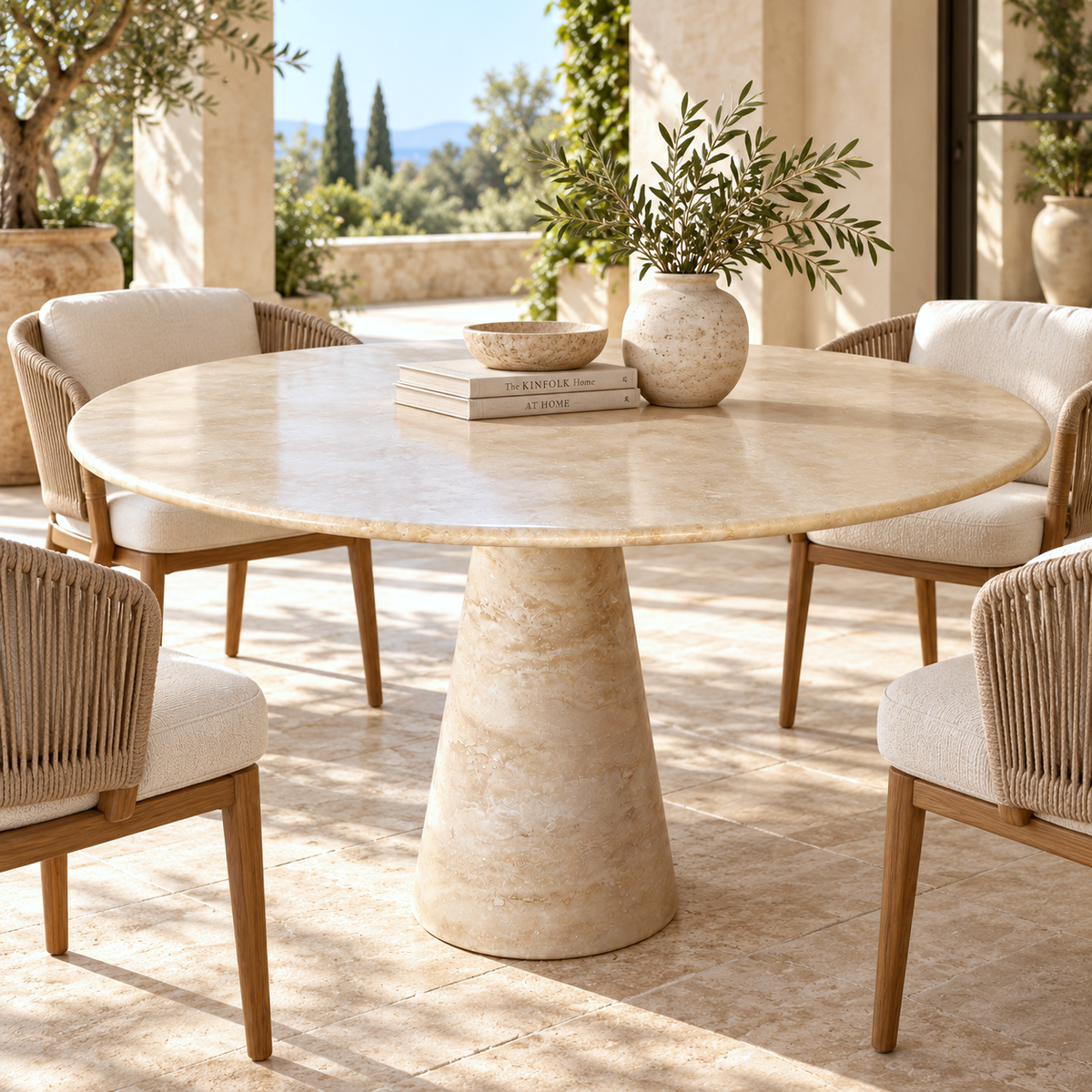
Travertine vs. Marble Dining Tables: Which Is Right for Your Home?
A natural stone dining table can transform an ordinary dining room into a sophisticated, welcoming space. Two of the most admired materials for luxury dining furniture are travertine and marble.
Both offer timeless appeal, distinctive patterns, and the beauty of genuine natural stone. However, they differ in appearance, texture, available finishes, and the atmosphere they bring to a room.
If you're choosing between a travertine dining table and a marble dining table, this guide will help you understand the differences and find the right piece for your home.
1. What Is the Difference Between Travertine and Marble?
Travertine and marble are both natural stones, but they have different geological origins and visual characteristics.
Travertine is a form of limestone associated with mineral deposits from water. It often features warm beige, cream, ivory, and earthy tones, along with distinctive pores and layered patterns.
Marble is a metamorphic stone formed when limestone or other carbonate-rich rock undergoes heat and pressure. Marble is known for its varied veining, elegant patterns, and wide range of colors.
Both materials can be shaped into beautiful dining tables, but each offers a different design personality.
2. Appearance: Warm Minimalism or Dramatic Elegance?
Travertine Dining Tables
Travertine is an excellent choice for interiors that emphasize warmth, texture, and understated sophistication.
Light beige travertine pairs beautifully with natural wood, linen upholstery, soft neutral colors, and architectural spaces.
Its subtle variation and matte finishes make it particularly appealing in minimalist, Mediterranean, Japandi, and Wabi-Sabi-inspired interiors.
A round travertine dining table with a sculptural pedestal base can become a focal point without overwhelming the room.
Marble Dining Tables
Marble is often chosen for its striking veining and polished or honed surfaces.
White marble with gray veining can create a bright, refined atmosphere, while darker varieties may provide a bold architectural statement.
Marble works especially well in contemporary, classic, and glamorous interiors.
Which should you choose?
If you prefer soft, organic textures and a warm, relaxed atmosphere, travertine may be the better fit.
If you enjoy dramatic patterns, strong contrast, or a more formal aesthetic, marble may suit your style.
3. Durability: Is Travertine or Marble Better for Everyday Use?
Both travertine and marble can be used for dining tables, but neither should be treated as a maintenance-free material.
Their performance depends on the specific stone, surface finish, fabrication quality, and daily use.
Because both are generally calcium-carbonate-based materials, acidic substances such as lemon juice and vinegar can damage their surfaces.
A protective stone treatment can help reduce liquid absorption, but it cannot make natural stone completely stain-proof or resistant to acid etching.
For everyday dining, the best approach is to use coasters and placemats, clean spills promptly, and avoid placing heavy or sharp objects directly on the surface.
A well-crafted natural stone dining table can provide many years of use when properly cared for.
4. Maintenance: Which Stone Is Easier to Clean?
Neither material is automatically easier to maintain in every situation.
A filled, honed travertine surface may be convenient for daily cleaning because its natural pores have been treated to create a smoother finish.
Marble can also be relatively straightforward to clean, particularly with a properly maintained surface.
For both materials, we recommend:
-
Wiping surfaces with a soft, damp microfiber cloth.
-
Using a mild, pH-neutral cleaner formulated for natural stone.
-
Cleaning coffee, tea, wine, oil, and food spills promptly.
-
Avoiding acidic and abrasive household cleaning products.
-
Using coasters, placemats, and trivets.
-
Following the manufacturer's instructions for protective treatment and maintenance.
The most important factor is understanding the characteristics of your particular stone and finish.
5. Which Material Works Best With Your Interior Style?
A dining table should feel connected to the room around it.
Minimalist interiors: Beige travertine complements uncluttered spaces, simple silhouettes, and neutral color palettes.
Mediterranean interiors: Warm travertine combines beautifully with textured walls, natural wood, and soft fabrics.
Japandi and Wabi-Sabi interiors: Honed travertine can bring subtle texture and visual warmth to restrained, thoughtfully furnished spaces.
Contemporary luxury interiors: Both travertine and marble work beautifully. Travertine creates an understated statement, while heavily veined marble can introduce stronger visual contrast.
Classic interiors: Marble is often a natural choice, although travertine can provide a softer interpretation of traditional elegance.
There is no universal winner. The right material depends on the feeling you want your dining room to convey.
6. Choosing the Right Dining Table Size and Shape
Material is only one part of selecting the ideal dining table.
The dimensions and proportions of the table are equally important.
Round dining tables are especially appealing because they encourage conversation and create a balanced visual centerpiece.
Before choosing a diameter, consider:
-
How many people will regularly use the table.
-
The available floor space around it.
-
The width of nearby walkways.
-
The placement of dining chairs.
-
The table's pedestal dimensions and legroom.
-
The weight and installation requirements.
For example, a 90 cm round table may suit a smaller dining area, while larger diameters can provide additional surface space.
Actual seating capacity depends on chair widths, place settings, and the amount of room required for comfortable dining.
With solid natural stone furniture, it is also important to plan for delivery access, floor suitability, and professional handling.
7. Why Choose a Handmade Travertine Dining Table?
A handmade travertine table offers more than a place to gather.
Every stone slab has its own variations in color, veining, and surface character. Skilled craftsmanship transforms that material into furniture with carefully considered proportions and finishes.
At Estramina, our dining tables are handcrafted in Türkiye using genuine natural stone.
We focus on sculptural silhouettes, elegant proportions, and finishes that complement the authentic character of travertine.
Many of our designs can also be discussed in different dimensions and stone selections, allowing customers to choose furniture that better suits their space.
Our approach emphasizes thoughtful design, careful workmanship, and timeless materials.
8. Travertine vs. Marble: A Quick Comparison
| Feature | Travertine | Marble |
|---|---|---|
| Typical appearance | Warm, layered, subtly textured | Varied veining, from subtle to dramatic |
| Common tones | Beige, cream, ivory, silver | White, gray, black, green, and more |
| Popular finishes | Honed, filled, textured | Polished, honed, textured |
| Design character | Warm and understated | Refined and often expressive |
| Acid sensitivity | Generally sensitive | Generally sensitive |
| Routine care | Gentle cleaning and prompt spill removal | Gentle cleaning and prompt spill removal |
| Best choice | Depends on your preferred look and finish | Depends on your preferred look and finish |
Both materials deserve careful handling and maintenance.
9. Final Thoughts: Which Dining Table Should You Choose?
Choose travertine if you love warm neutral colors, subtle textures, and furniture that feels calm, sculptural, and understated.
Choose marble if you prefer pronounced veining, bold visual contrast, or a more dramatic statement.
Both can be beautiful choices for a dining room when the stone, finish, and table construction are appropriate for the intended use.
At Estramina, we believe the best furniture brings together authentic materials, skilled craftsmanship, and thoughtful design.
Explore Our Handcrafted Travertine Tables
Discover our collection of natural stone dining tables, handcrafted in Türkiye and thoughtfully designed for interiors around the world.
Looking for a custom size or a specific stone finish? Contact Estramina to discuss your project.